
The Riviera Maya sea turtle nesting season generally runs from May through October. The first nests may appear as early as April, while hatchlings from late nests can continue emerging into November and occasionally December.
If you live here or are visiting during these months, you’re sharing the shoreline with animals whose ancestors have followed these migration routes for millions of years. Their survival depends in part on what happens once they reach the beach.
Which sea turtles nest in the Riviera Maya?
Four species of sea turtle have been recorded nesting along the coast of Quintana Roo:
- Green turtle (Chelonia mydas), also called the white turtle in Mexico
- Loggerhead turtle (Caretta caretta)
- Hawksbill turtle (Eretmochelys imbricata)
- Leatherback turtle (Dermochelys coriacea)
Green and loggerhead turtles account for most nests in the Riviera Maya. Hawksbill nests are much less common, while leatherback nests are exceptionally rare.
In Akumal, the nesting population is overwhelmingly made up of green and loggerhead turtles.
Adult females may travel hundreds or even thousands of kilometers between their feeding and nesting grounds. Many return to the same general region where they hatched, a behavior known as natal homing. Scientists believe the Earth’s magnetic field helps turtles recognize the coastline where they were born.
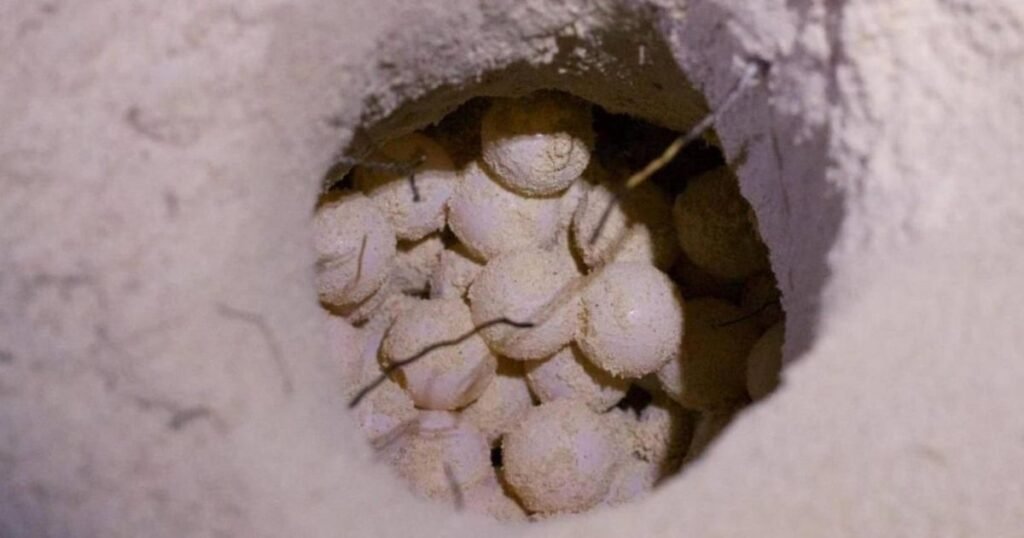
The sea turtle nesting cycle
The stages of the sea turtle nesting season in the Riviera Maya overlap. There is no single month when all turtles are mating, nesting or hatching at the same time.
Mating
Mating generally takes place offshore before and during the early part of nesting season. A female may mate with more than one male and can store sperm to fertilize several clutches of eggs.
Nesting
Females normally come ashore at night. They crawl above the high-tide line, use their rear flippers to dig an egg chamber and deposit a clutch of soft-shelled eggs.
Depending on the species, an individual female may nest several times in one season, usually at intervals of about two weeks. A typical clutch contains approximately 80 to 130 eggs, although the number can be higher or lower.
After covering and disguising the nest, the female returns to the sea. She does not remain to protect the eggs.
Incubation
The eggs generally incubate for about 45 to 70 days. Development depends heavily on sand temperature, moisture and the location of the nest.
Temperature also helps determine the sex of the hatchlings. Warmer nests tend to produce more females, while cooler nests tend to produce more males. This makes rising sand temperatures an increasingly serious concern for turtle populations.
Hatching
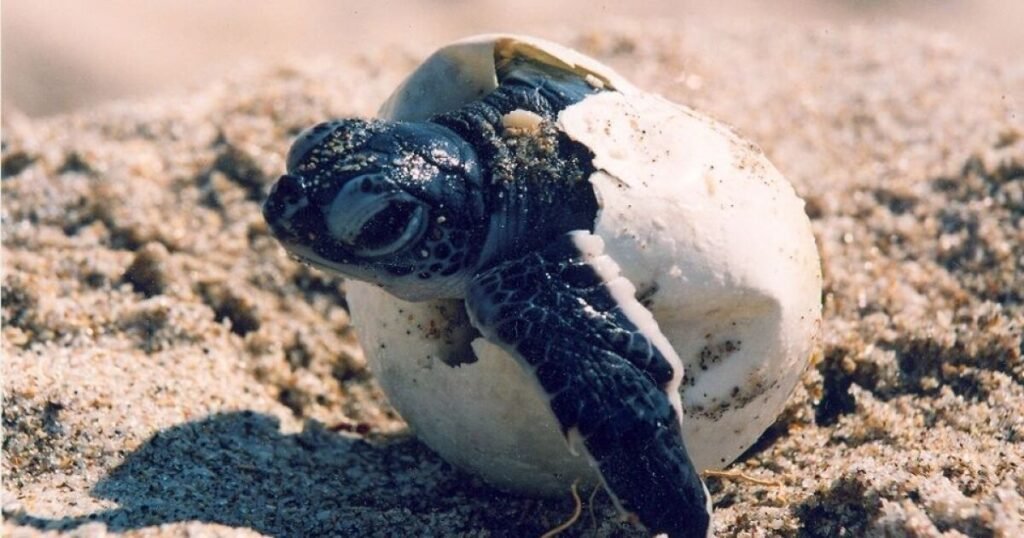
When they are ready, hatchlings break through their shells using a temporary egg tooth. They usually remain below the surface until much of the clutch is ready to emerge.
The group then works its way upward through the sand. When dozens of hatchlings emerge almost simultaneously, the movement is sometimes called a “boil.”
Most emerge at night, when the sand is cooler and there are fewer predators. They orient themselves toward the open horizon and the natural glow reflected from the sea.
Artificial lights from hotels, condominiums, restaurants, streets and beach homes can send them in the wrong direction.
Sea turtle nesting numbers for 2025
Sea turtle nesting numbers can change dramatically from one year to the next, particularly for green turtles. A sharp rise or fall does not necessarily represent a matching change in the overall population.
Many females do not nest every year. Ocean conditions, storms, erosion, beach access, temperature and heavy sargassum can also affect where and when they come ashore.
Akumal nesting activity
Centro Ecológico Akumal reported that 271 loggerhead nests were marked during the 2025 season on the beaches monitored by its turtle camp.
Earlier in the season, CEA reported 249 total nests as of July 8, including 162 loggerhead and 87 green turtle nests. CEA has not published a complete final 2025 species breakdown that could be independently verified.
The 2025 season was especially difficult in parts of Akumal. Heavy sargassum created steep banks and dense barriers that made it harder for females to reach suitable nesting areas.
Half Moon Bay recorded its lowest early-July nest count in five years, according to the Akumal Norte neighborhood association. However, that comparison was made while the season was still underway.
Municipality of Tulum totals
The Municipality of Tulum, which includes a much larger stretch of coastline and multiple turtle camps, reported the following final numbers for 2025:
- Green turtle nests: 15,848
- Loggerhead nests: 2,309
- Hawksbill nests: 3
- Total nests protected: 18,160
- Hatchlings reaching the sea: 1,085,347
These numbers cover the entire municipality, not Akumal alone. They show just how important the Tulum coastline remains to sea turtle reproduction in the Mexican Caribbean.
How to help during sea turtle nesting season
Mexico has specific rules governing human activity around nesting turtles and hatchlings. If you encounter a turtle during the Riviera Maya sea turtle nesting season, conservation groups recommend that you:
- Stay at least 10 meters away and remain behind her, out of her line of sight.
- Do not touch, follow or stand in front of her.
- Do not use flash photography, flashlights or phone lights.
- Keep noise and movement to a minimum.
- Never sit on or restrain a turtle.
- Do not touch the eggs or attempt to uncover a nest.
- Do not remove stakes, signs, protective barriers or identification markers.
- Keep dogs leashed and away from nesting areas.
- Remove beach furniture, toys and other obstacles at night.
- Fill in holes and flatten large sandcastles before leaving the beach.
- Avoid bonfires, fireworks and loud music near nesting areas.
- Take fishing line, plastic bags and all other trash with you.
- Report injured, trapped or disoriented turtles to local authorities or a recognized turtle camp.
Beachfront properties should reduce or shield lights that can be seen from the beach. Curtains should be closed after dark, and exterior lighting should be kept low and directed away from the sand.
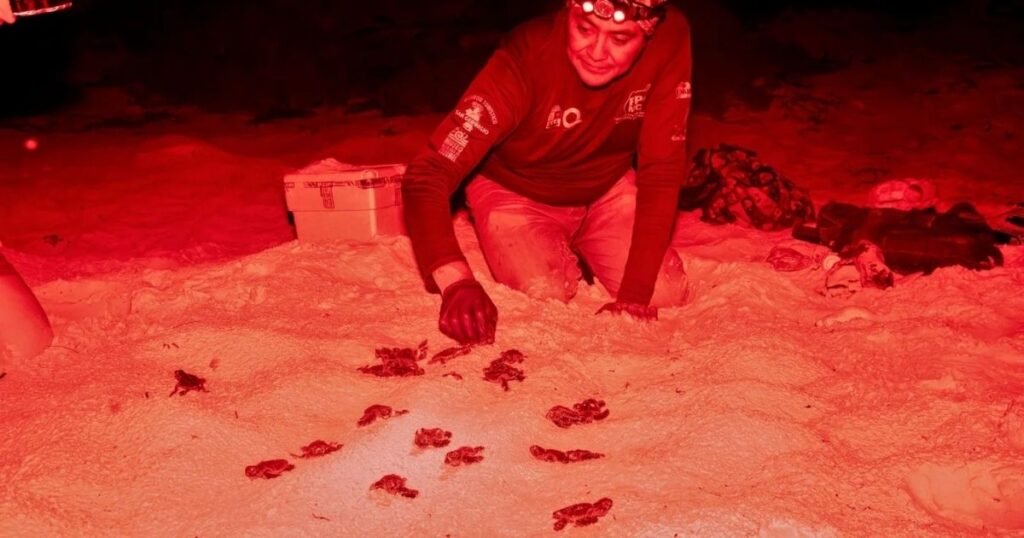
Red lights may be used by trained turtle-camp personnel under controlled conditions. This should not be treated as permission for visitors to approach or illuminate a nesting turtle.
What to do if you see hatchlings
Hatchlings normally emerge together and make their way toward the sea without human assistance. Their crawl across the sand helps build strength and allows them to orient themselves before entering the water.
Do not pick them up, place them in buckets or carry them directly to the surf unless a trained conservation worker tells you to do so. Never organize an informal turtle release.
If hatchlings are moving away from the water, artificial lighting is often the cause. Turn off nearby lights if it is safe to do so and contact the local turtle camp or authorities. Do not shine another light toward the ocean in an attempt to guide them unless instructed by a conservation specialist.
The frequently repeated estimate that only one in 1,000 hatchlings survives to adulthood is best understood as an approximation. Survival varies by species, location and environmental conditions, but mortality is extremely high during the first years of life.
Only female turtles come ashore
With the exception of hatchlings leaving their nests, only adult female sea turtles normally come onto the beach. Males remain at sea throughout their lives.
Females generally take decades to reach maturity. Green turtles may not begin reproducing until they are 25 to 40 years old or even older. A turtle nesting in Akumal today may have hatched from the same coastline several decades ago.
Want to do more?
Several organizations support conservation work during sea turtle nesting season in the Riviera Maya:
- Centro Ecológico Akumal
- Xcacel-Xcacelito Sea Turtle Sanctuary
- Flora, Fauna y Cultura de México A.C.
- S.A.V.E. Mexico
Volunteer patrols and turtle releases should always be organized through an authorized conservation program. Public releases may not be offered every season or at every location, and participation should never involve handling turtles simply for photographs.
Sea turtles have been returning to the Riviera Maya since long before hotels, beach clubs and vacation homes occupied the coastline. Giving them darkness, distance and an unobstructed stretch of sand is one of the simplest ways we can help them continue.