
This is an update to our original VISITAX article, first published in January 2024. It has been revised in November 2026 to reflect current rates, payment options, and a major shift in enforcement at the Cancun airport.
If you’re planning a trip to Quintana Roo, Mexico, chances are you’ve heard something about the Quintana Roo VISITAX, the tourist tax required of nearly all foreign visitors to the state. Even if you’re a regular visitor and have paid it before, the rules around it have shifted meaningfully over the past couple of years, especially when it comes to enforcement at the airport.
Here’s what you need to know to stay in compliance on your next trip.

What Is VISITAX?
VISITAX is a tourism tax levied by the state of Quintana Roo on international visitors, aimed at funding the maintenance and improvement of the state’s tourism infrastructure, environmental conservation, and new tourist attractions. Quintana Roo is home to popular destinations such as Cancun, Isla Mujeres, Tulum, Cozumel, and Playa del Carmen (and, of course, Puerto Aventuras).
Quintana Roo introduced VISITAX in 2021, when the region was still reeling from the pandemic’s effect on tourism; it may have been conceived partly as a way to jump-start the sector’s recovery. In December 2022, Article 51-Octies of the state’s Law of Rights was amended to make VISITAX mandatory for all international visitors.
Funds collected through VISITAX are administered by the Quintana Roo Tax Administration Service (SATQ) and are meant to go toward beach restoration, maintenance of public spaces, and other tourism-facing infrastructure. In practice, the state has said it expects VISITAX to be one of its largest sources of new revenue in 2026, with a target of roughly 3 billion additional pesos in tax collection tied directly to the fee.
Travelers entering or departing through any of Quintana Roo’s international airports, including Cancun, Cozumel, Tulum, and Chetumal, are expected to pay it.

Who Is Required to Pay VISITAX?
VISITAX applies to all foreign visitors entering Quintana Roo for tourism, business, or educational purposes.
There are a few notable exemptions:
- Mexican nationals living abroad and foreigners who are temporary or permanent residents of Mexico are not required to pay. No separate proof of residency is required, since that status is tied to your passport or immigration record.
- Foreign tourists entering and departing Quintana Roo through the southern land border with Belize are also exempt.
One point worth flagging rather than guessing at: sources disagree on whether there’s a minimum age exemption. Some outlets report VISITAX applies to “ages 4 and up,” while others state plainly that there is no general age exemption and children are included. We were not able to confirm a firm age cutoff directly from the official visitax.gob.mx FAQ, so if you’re traveling with young children, it’s worth checking the current rules on the official site before you pay rather than assuming either way.
How Much Is Quintana Roo VISITAX?
As of late 2025, the Quintana Roo government announced VISITAX would hold at 285 MXN per person (roughly $15–16 USD) through 2026, with no increase planned for the year (Riviera Maya News).
That said, there’s real confusion around the exact number right now: the head of the state’s tax administration service (SATQ) has separately cited a rate of 293 pesos, and travelers have reported being asked for as much as 550 pesos at airport collection points — nearly double the official rate. Treat anything beyond roughly 285–293 MXN per person as a red flag, and always confirm the current rate directly on the official site before paying.
This fee is a fixed, one-time rate per person, per visit, regardless of how long you stay or how many destinations within Quintana Roo you visit.
How to Pay Your Quintana Roo VISITAX
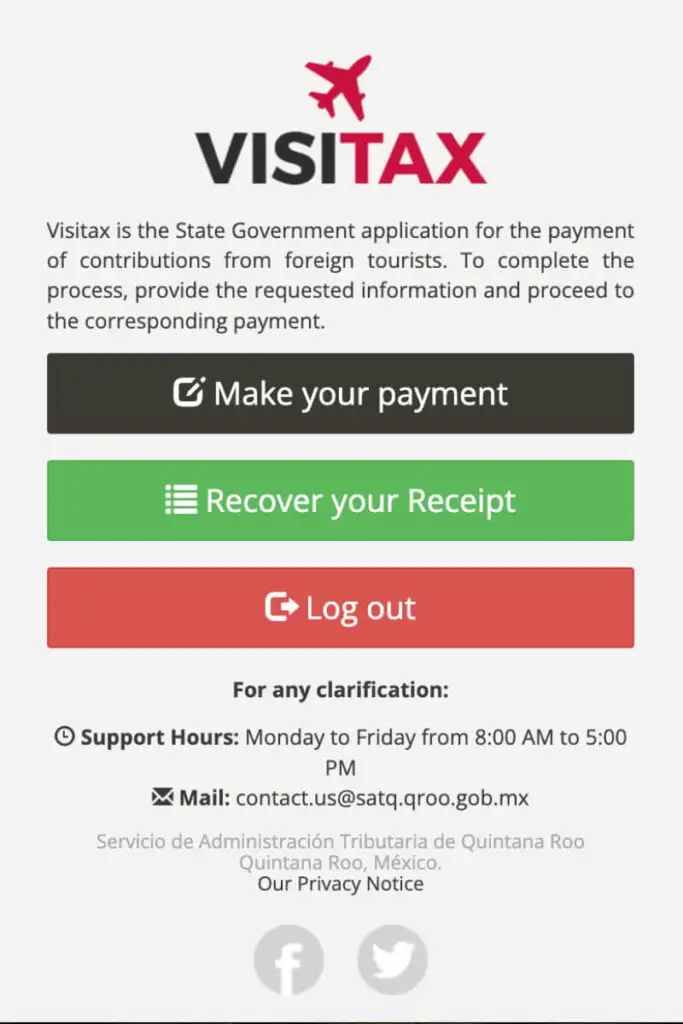
There’s one legitimate way to pay VISITAX: the official government portal.
Pay via the official government portal
The current official site is visitax.gob.mx. You can pay before your trip, during your stay, or before you leave the state, and payment can be made up to a year in advance. You’ll need, for each traveler:
- Departure date from Quintana Roo
- Full name and birthdate
- Passport number (a valid passport book is required; passport cards are not accepted for air travel)
- A valid email address
Once payment is processed by debit or credit card, you’ll receive a QR code by email — this is your proof of payment. Save it on your phone and, if possible, print a copy too.

What’s changed since this was first published: enforcement and the hotel-collection question
Two things are genuinely different in 2026. First, hotels in Quintana Roo will not collect VISITAX on your behalf, after state authorities formally confirmed hotels would not act as collectors, so don’t expect to see it quietly added to your room bill (Travel Market Report). Second, and more importantly, enforcement at Cancun International Airport has ramped up significantly.
Dedicated VISITAX checkpoint teams are now stationed in the terminals, checking QR codes before passengers reach security, rather than relying on the honor system that prevailed in earlier years. Our strong recommendation: pay online at least 24 hours before your flight, rather than waiting until you’re at the airport.
Avoiding Fake VISITAX Websites and Scams
Scam sites remain the single biggest VISITAX risk, and if anything, they’ve multiplied. Dozens of lookalike sites continue to charge $30-50 USD or more for what should cost around $15-16 USD, using convincing URLs. The golden rule hasn’t changed: the only official site is visitax.gob.mx. Anything else, however legitimate it looks, isn’t authorized to collect this tax.
A few reminders:
- You should never be asked to pay VISITAX in cash on arrival, by anyone including someone presenting themselves as a government official.
- You should never be charged meaningfully more than the official rate (roughly 285–293 MXN), aside from a legitimate service fee if you’ve asked a licensed travel agent to process the payment for you.
If you think you’ve paid through a fraudulent site:
- Check your payment status on the government portal. A “no record found” result means there’s no official record of your payment.
- Dispute the charge with your credit card company.
- Repurchase your VISITAX through the official channel, visitax.gob.mx.
Enforcement and Compliance
This is the section that’s changed the most since this article first ran. For the first few years after VISITAX launched, enforcement was essentially an honor system. Travelers paid, or didn’t, with little follow-up.
That’s no longer the case. In 2026, Cancun International Airport rolled out a dedicated checkpoint strategy, with staff stationed in the terminals checking QR codes before travelers reach the security line. If you can’t produce a valid QR code, you may be directed to pay on the spot, which can mean a stressful scramble before your flight, or, per some traveler reports, being asked to pay well above the official rate at airport collection points.
The practical takeaway hasn’t changed, it’s just more urgent: pay online, well before you get to the airport, and keep your QR code accessible on your phone (and ideally printed as backup). Your travel information is stored on SATQ’s servers for up to a year if you need to retrieve a lost QR code.
Cruise ship passengers on closed-loop itineraries, and travelers entering Quintana Roo overland from Yucatán or Campeche (by car, bus, or the Tren Maya), still fall into something of a gray area, since there’s no immigration checkpoint at those crossing points to flag unpaid VISITAX, so by the letter of the law the tax is owed, but it isn’t actively enforced for those travelers the way it now is at the Cancun airport.

Other Taxes Travelers to Quintana Roo Should Know About
VISITAX isn’t the only fee travelers to Quintana Roo should expect. Here’s where things stand with the others as of late 2026:
- DNR (Derecho de No Residente), federal tourist/immigration fee. Who pays: all non-resident foreign visitors. Current rate: 983 MXN per person (2026); a 2027 increase to roughly 1,159 MXN has been approved by the Senate but not yet published in the DOF. How it’s collected: bundled into your airfare; nothing to pay separately.
- TUA (Tarifa de Uso Aeropuertuario), federal airport usage fee. Who pays: all air passengers. Current rate: varies by airport and flight type (domestic vs. international); check your airline’s fee breakdown for the exact current figure. How it’s collected: bundled into your airfare.
- Environmental Sanitation Tax (Derecho de Saneamiento Ambiental), municipal. Who pays: hotel guests, charged per room per night. Current rate: Cancun, about 76-79 MXN/room/night (70% of the daily UMA); other Quintana Roo municipalities, including the Playa del Carmen municipality where Puerto Aventuras sits, about 30% of the UMA, roughly 34-35 MXN/room/night. How it’s collected: collected by the hotel at check-in or check-out.
- Cruise passenger fee (the cruise-specific version of the federal DNR). Who pays: cruise ship passengers calling at a Quintana Roo port. Current rate: $5 USD per person starting July 2025, doubled to $10 USD per person as of August 1, 2026, with further scheduled increases through 2028. How it’s collected: collected in advance by the cruise line, built into your fare.
Worth clarifying: the cruise passenger charge isn’t a separate “Environmental Tax” unique to Quintana Roo; it’s the cruise industry’s version of the federal DNR, administered nationally, not a state or municipal fee.
Worth noting locally: starting in 2026, the Playa del Carmen municipality (which includes Puerto Aventuras) is extending Environmental Sanitation Tax collection to short-term vacation rentals, not just hotels, so if you’re renting a condo or villa here rather than staying at a hotel, don’t be surprised if this shows up on your rental bill going forward.

VISITAX Frequently Asked Questions
How much does VISITAX cost? Around 285-293 MXN per person as of late 2026, confirm the current rate on visitax.gob.mx before paying.
Is a printed copy of the VISITAX receipt required? Not mandatory, but strongly recommended given increased checks at the airport. Keep both a digital copy on your phone and a printed backup.
Is VISITAX applicable only to certain nationalities? No. It applies to all international visitors not otherwise exempt by Mexican immigration status.
Who is exempt from paying VISITAX? Mexican nationals; temporary and permanent residents of Mexico; and travelers entering/exiting Quintana Roo through the southern Belize border.
Is VISITAX included in the cost of my flight? No. No airline bundles VISITAX into the airfare — it must be paid separately, online.
Can I pay VISITAX at the Cancun Airport? No, it still can’t be paid at a counter inside the airport terminal. It must be paid online, in advance, on visitax.gob.mx.
Will I be stopped at the airport if I haven’t paid? This is the biggest change since VISITAX launched. As of 2026, dedicated checkpoint teams check for your QR code before security at Cancun International Airport. Pay online before you arrive at the airport to avoid delays.
Does VISITAX vary by length of stay? No, it’s a fixed one-time fee per person, per visit, regardless of how long you stay.
What if I visit multiple destinations within Quintana Roo, or enter and exit through different airports? VISITAX is a one-time fee regardless of how many Quintana Roo destinations you visit, and it applies no matter which of the state’s airports (Cancun, Cozumel, Tulum, or Chetumal) you use to enter or exit.
Is VISITAX refundable if my trip is canceled? Generally, no.
VISITAX isn’t going anywhere, and 2026 has made clear that the state is finally serious about collecting it. The good news is the process itself hasn’t gotten any harder. Pay early, through an official channel, and keep your QR code handy. We’ll keep this page updated as enforcement, pricing, or the payment process continues to evolve. Questions about your own trip? Drop them in the comments and we’ll do our best to help.
Our original VISITAX article was published in January 2024. This information is current as of November 2026.